About Us
HICS is a small, independent research and education institute in Lalitpur, Nepal. We build scientific instruments for the conditions here, and use them for research and for learning in the same places. It is early: one founder, a first prototype tested on the bench, and a long working relationship with schools in Dolpo.
Founder
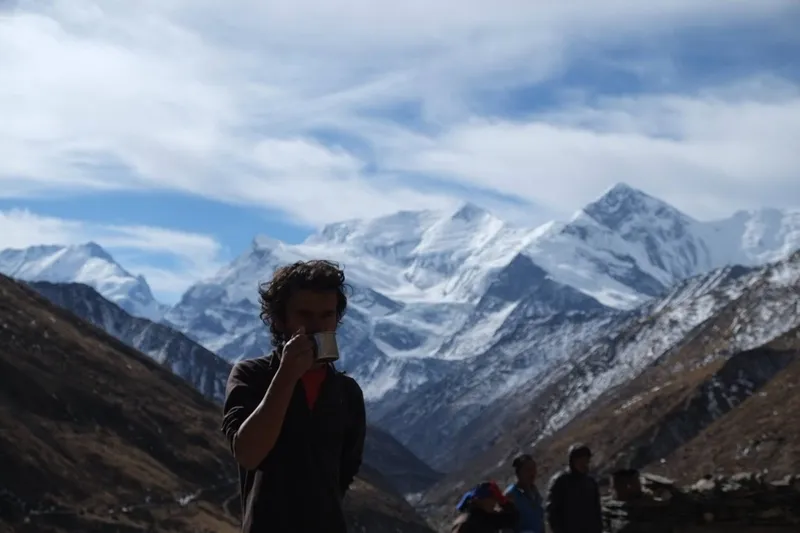
Pawan Dhakal
Founder and Director
Pawan Dhakal works on science education, scientific instruments and research rooted in Nepal's own places. He trained as a physicist: he studied physics and mathematics at Dartmouth College and took an M.Sc. in physics at The Ohio State University, where he worked on dark matter and published a study that uses meteor radar to search for it (Physical Review D, 2023).
He taught in schools at 3,000–4,000 m in Upper Mustang and Dolpo in 2016–17 and set up offline computer labs there. He then spent several years designing offline lessons and learning platforms for schools across Nepal at Open Learning Exchange Nepal. Since 2021 he has worked with Vision Dolpo on Crystal Mountain School in Dho Tarap, including its passive-solar buildings.
Research, learning, and the tools for both
Nepal rises from 60 m to 8,849 m in under 200 km, and much of what happens across that height goes unmeasured: the air above the lowland stations, how a stone building holds heat at 4,000 m, where a valley's debris flows run, how many cosmic-ray particles reach a mountain school, and how a student reached an answer that an exam only marks right or wrong. HICS builds instruments for those questions, here and for the conditions here: offline, solar-powered where they need to be, and repairable by the people who use them.
Our research starts from the places it studies. Its questions come from them, and it answers to the values of the people who live there: work they can see, use and take part in, and care for the place itself.
Learning, here, is a form of inquiry. A student who builds an instrument, measures with it and argues from what it records is doing research at their own level, and the same instrument serves a researcher comparing sites along a transect. So the instruments go to schools, colleges and communities.
We want what we make to strengthen research and learning beyond HICS: open designs, offline lessons and open records that other schools, colleges and researchers can build on. The designs are published as they are finished, at github.com/hics-nepal.
Crystal Mountain School and Vision Dolpo
The work in Dolpo is older than HICS: it grew out of the founder's teaching there. Crystal Mountain School, in Dho Tarap, teaches from playgroup to Grade 10. Vision Dolpo, a nonprofit founded by its alumni, works on education, health and energy in the valley. HICS works with both on the school's passive-solar buildings.
The current project is the school's multipurpose hall, which is going up now. As its walls rise, 25 temperature sensors are being set into them, so that the building can be measured through its first winters. → Building physics · → Photographs
All of it rests on long-standing relationships with the communities of Dho Tarap and on work with local government in Dolpo.
AIT Nepal 2026/27
HICS is in the 2026/27 cohort of Academia-Industry Training (AIT) Nepal, run by the Swiss Leading House South Asia at ZHAW. At its Swiss Week in Zurich in September 2026, Pawan's pitch to the investor and industry panel was singled out for its clarity and impact. The programme continues in Nepal in March 2027. → The note
The next few years
- A transect, a line of sites at rising altitude from Nepalgunj on the plains up to Dolpo, each with an IESH hub and a muon detector, and a set of IESH hubs in and around the Kathmandu valley.
- 50 schools, each with a full environmental station (weather and air quality), the learning modules that use its readings, and training for the teachers who run it.
We are raising the money for this through grants.
Registration
Himalayan Institute for Contextual Sciences Pvt. Ltd., registered in Lalitpur, Nepal.